The Future of Fitness: How AI and Wearable Technology Are Changing Workouts
Author: RVLNSV PRASAD
Updated On: October 2026
About Us
Author Bio
Editorial Policy
Contact Us
Quick Answer
The future of fitness is not simply about owning a smarter watch or asking artificial intelligence to create a workout.
It is moving toward a more connected system in which wearable sensors collect information, software interprets patterns, and AI helps turn those patterns into practical suggestions.
That could mean adjusting a workout after poor sleep, changing exercise intensity when recovery appears lower than usual, identifying movement patterns, or helping a beginner stay consistent.
However, technology should support exercise decisions rather than completely control them.
The latest evidence shows that wearable devices can help increase physical activity, particularly when they are combined with behavioral support or coaching. At the same time, researchers continue to find meaningful differences in the accuracy of metrics such as calorie expenditure, sleep stages, exercise intensity, and estimated VO₂max.
AI has an even bigger limitation. A 2026 systematic review found that current large language models can produce useful exercise recommendations, but they are not yet reliable replacements for qualified exercise professionals, especially for people with medical conditions or more complicated exercise needs.
The most useful future of fitness therefore looks less like “AI replaces the trainer” and more like
Sensor → Data → Interpretation → Human decision → Action → Feedback
That distinction matters.
Introduction: Fitness Is Becoming More Intelligent, But Not Automatically Better
For years, fitness technology mainly answered one question:
What did I do today?
Your phone counted steps. A smartwatch measured heart rate. A fitness app recorded your workout. A wearable estimates calories burned.
That was already useful.
But the next stage is different.
Technology is increasingly trying to answer:
“What should I do next?”
That is where artificial intelligence, wearable sensors, and personalized fitness software are beginning to overlap.
The American College of Sports Medicine placed wearable technology at number one in its 2026 worldwide fitness trends, based on a survey involving about 2,000 clinicians, researchers, and exercise professionals. ACSM also highlighted the continuing growth of data-driven technology and the use of physiological information to personalize exercise.
ACSM: The Future of Fitness—2026 Worldwide Fitness Trends
This does not mean technology automatically produces better health.
A smartwatch cannot make you exercise.
An AI-generated workout cannot replace sleep.
A recovery score cannot tell you exactly how your body feels.
And a calorie estimate should not determine how much food you eat.
The real opportunity is more practical: technology can reduce some of the guesswork involved in planning, tracking, and adjusting exercise.
That is the direction this article explores.
What Does the Future of Fitness Actually Mean?
The future of fitness means a shift from basic activity tracking toward more personalized, responsive, and connected exercise.
Instead of giving everyone the same workout, future systems may increasingly consider information such as:
- Recent training history
- Heart-rate response
- Sleep patterns
- Resting heart rate
- Heart-rate variability
- Exercise intensity
- Movement patterns
- Workout consistency
- Recovery indicators
- Personal goals
- Available equipment
- Training preferences
- Previous performance
Artificial intelligence can then help interpret those inputs.
For example, imagine someone normally completes a 30-minute strength workout three times a week.
Their wearable notices that their sleep has been shorter than usual and that their recent training load has increased.
A good system should not simply say:
“You burned fewer calories. Work harder.”
A better system might suggest:
“Consider reducing today’s intensity or choosing a shorter recovery-focused session.”
That is a much more useful application of technology.
Why Wearable Technology Is Leading the Change
Wearable fitness technology has developed far beyond simple step counters.
Modern devices may collect information about:
- Heart rate
- Steps
- Distance
- Sleep
- Workout duration
- Exercise intensity
- Heart rhythm
- Skin temperature
- Blood oxygen
- Estimated VO₂max
- Recovery indicators
- Training load
ACSM’s 2026 fitness trends report notes that newer wearable technologies are incorporating increasingly sophisticated biosensors and can support self-monitoring, accountability, and individualized coaching.
But there is an important point that many fitness articles miss:
More data does not automatically mean better decisions.
A person who receives 25 health metrics every morning may actually become more confused.
The future of fitness will therefore depend not only on collecting information but also on interpreting it correctly.
The Most Important Shift: From Data to Decisions
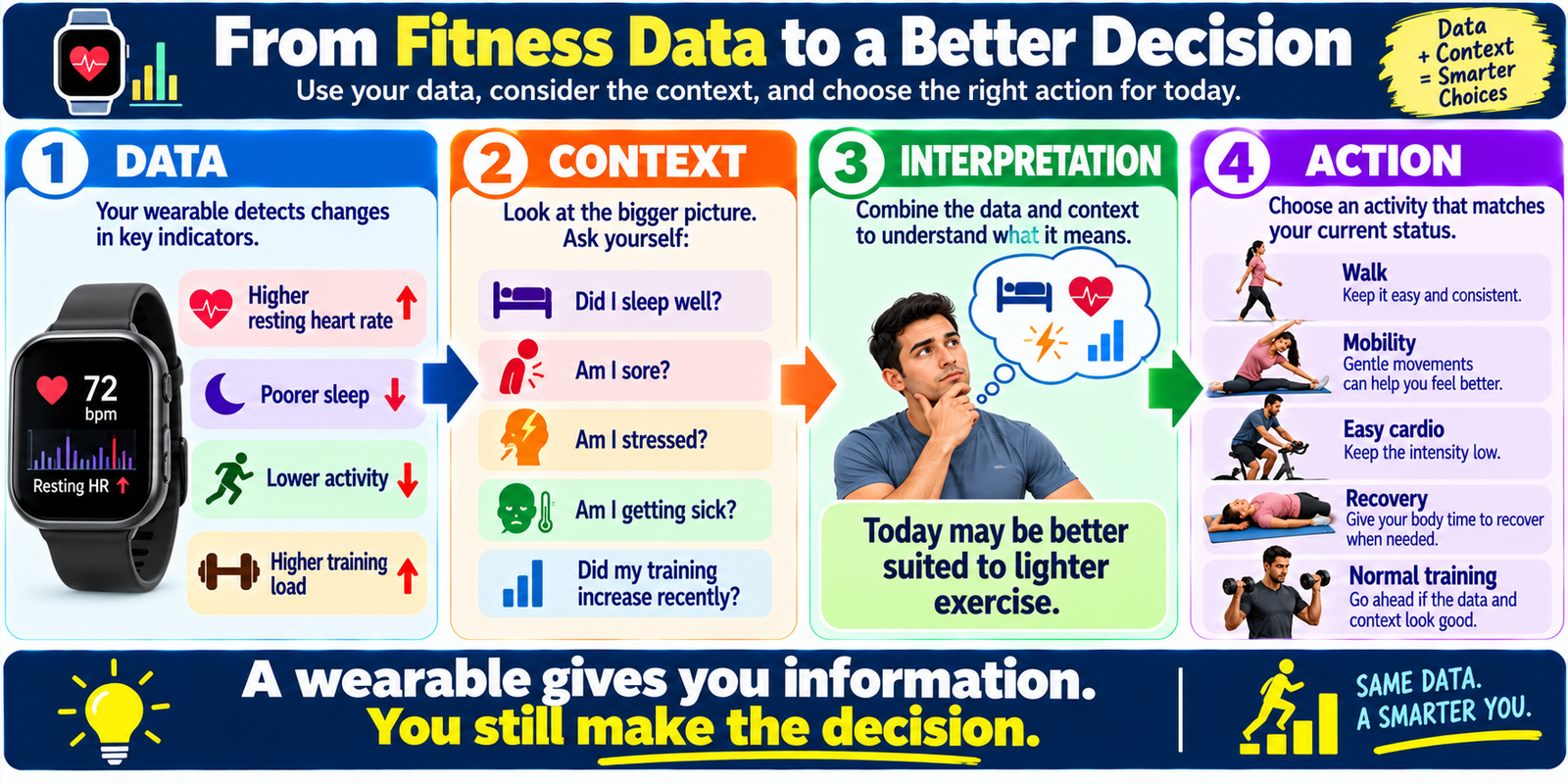
One of the biggest opportunities in smart fitness technology is converting raw numbers into understandable actions.
Consider this example:
| What the device shows | What it might mean | Better question | Possible action |
|---|---|---|---|
| Resting heart rate is higher. | Many possible causes | How do I feel today? | Consider easier training. |
| Fewer steps than usual | Less daily movement | Why was activity lower? | Add a short walk. |
| Poor sleep score | Sleep disruption may have occurred. | Did I actually sleep poorly? | Prioritize recovery. |
| Higher training load | More recent exercise stress | Am I recovering well? | Adjust intensity. |
| Lower workout performance | Fatigue, stress, or other factors | Is this a pattern? | Review several days. |
| Higher calorie estimate | Device-generated estimate | Is this metric reliable enough? | Avoid using it as an exact number. |
This is why I would describe the next generation of fitness as
Data → Context → Action
rather than simply:
Data → More data
What AI Is Actually Doing in Fitness
“AI in fitness” is a broad term.
It can refer to several different technologies.
1. Algorithmic recommendations
Some fitness apps use relatively simple rules.
For example:
If your previous workout was completed easily, increase resistance.
If you missed two sessions, suggest a shorter workout.
This is useful, but it does not necessarily require sophisticated generative AI.
2. Machine learning
Machine-learning systems can identify patterns from large amounts of information.
A system might learn how your exercise performance changes alongside sleep, training volume, or previous workouts.
The goal is to create increasingly individualized recommendations.
3. Computer vision
Camera-based systems can analyze movement.
Depending on the technology, they may attempt to identify:
- Squat depth
- Body position
- Repetition counting
- Exercise technique
- Movement symmetry
This could make home workouts more interactive.
However, camera-based exercise analysis should not be treated as equivalent to assessment by a qualified professional.
4. Generative AI
Large language models can create explanations, answer questions, and generate workout suggestions.
This is one of the fastest-growing areas.
A 2026 review in the Journal of Science and Medicine in Sport described AI as having potential in exercise programming and coaching, while also highlighting the gap between promising technology and the quality of evidence supporting commercial applications.
PubMed: Artificial Intelligence in Exercise Programming and Coaching
That gap is important.
A technology can sound intelligent without being clinically reliable.
The Biggest AI Fitness Development in 2026: Personalized Exercise Assistance
AI is becoming better at combining different pieces of information.
Imagine telling an AI fitness system:
“I have 20 minutes, no gym equipment, slept poorly, have mild muscle soreness, and want to improve cardiovascular fitness.”
A future system might build a session around those constraints instead of giving the same generic workout it gave yesterday.
That could include:
- A gradual warm-up
- Low-impact cardio
- Mobility work
- Moderate resistance exercises
- A shorter cool-down
The value comes from personalization.
However, personalization must not be confused with medical expertise.
A 2026 systematic review of 24 empirical studies involving 2,512 participants found that large language models showed promise but also important safety weaknesses. In head-to-head comparisons with human experts, AI-generated programs were inferior in most of the studies that assessed physiological adaptations, and safety problems were identified in a substantial portion of the evidence.
PubMed: The AI Recommendation Paradox
That leads to a simple rule:
Use AI to assist your thinking, not to remove your responsibility for sensible exercise decisions.
Can Wearables Really Make People More Active?
There is evidence that they can help.
A large umbrella review of systematic reviews found that wearable interventions can increase physical activity and reduce sedentary behavior in adults, although the strength of evidence varied between outcomes.
PubMed: Wearable Devices to Improve Physical Activity and Reduce Sedentary Behavior
Research involving older adults has also found improvements in physical activity and daily step counts from wearable-based interventions compared with usual care.
PubMed: Wearable Activity Tracker Interventions in Older Adults
The lesson is not that everyone needs a smartwatch.
The lesson is that feedback can make invisible behavior visible.
If you thought you walked frequently but your tracker shows very little movement during your working day, that information may help you change your routine.
The device becomes a mirror.
It is not the solution itself.
What Wearables Get Right—and What They Get Wrong
This is one of the most important sections for readers because many fitness websites present wearable data as if every number is medically precise.
It is not.
A living umbrella review of systematic reviews found that wearable accuracy varies substantially by measurement. Heart-rate estimates can perform reasonably well in many situations, while energy expenditure, activity intensity, VO₂max estimation, and sleep measurements can have much greater uncertainty.
PubMed: Keeping Pace With Wearables — Living Umbrella Review
A practical accuracy guide
| Wearable metric | How to use it | Main caution |
|---|---|---|
| Step count | Compare your own activity over time. | Accuracy varies with activity and device. |
| Heart rate | Useful for general exercise monitoring | Not identical to clinical ECG monitoring |
| Workout duration | Very useful | Usually straightforward but still device-dependent |
| Calories burned | Treat as an estimate. | Energy expenditure can have substantial error. |
| Sleep duration | Look for trends. | Not a replacement for clinical sleep testing |
| Sleep stages | Use cautiously. | Stage estimates can differ from laboratory testing. |
| VO₂ max estimate | Useful as a trend | Not equivalent to a laboratory measurement |
| Recovery score | Consider it as one signal. | Algorithms differ between companies. |
| HRV | Useful for trends in context | Day-to-day variation can be affected by many factors. |
The newest evidence continues to reinforce this cautious approach.
A 2026 systematic review found that consumer wearable sleep trackers showed poor-to-moderate agreement with validated subjective sleep assessments, with performance varying considerably between populations.
PubMed: Wearable Sleep Metrics and Patient-Reported Sleep Quality
Another 2026 systematic review and meta-analysis comparing wearable sleep tracking with polysomnography found that devices could provide useful estimates of broad sleep patterns but were not consistently reliable enough to replace laboratory sleep testing.
PubMed: Wearable Sleep Tracking Compared With Polysomnography
That is a crucial distinction.
Useful for tracking does not automatically mean suitable for diagnosis.
When Your Fitness Watch Should Not Make the Decision
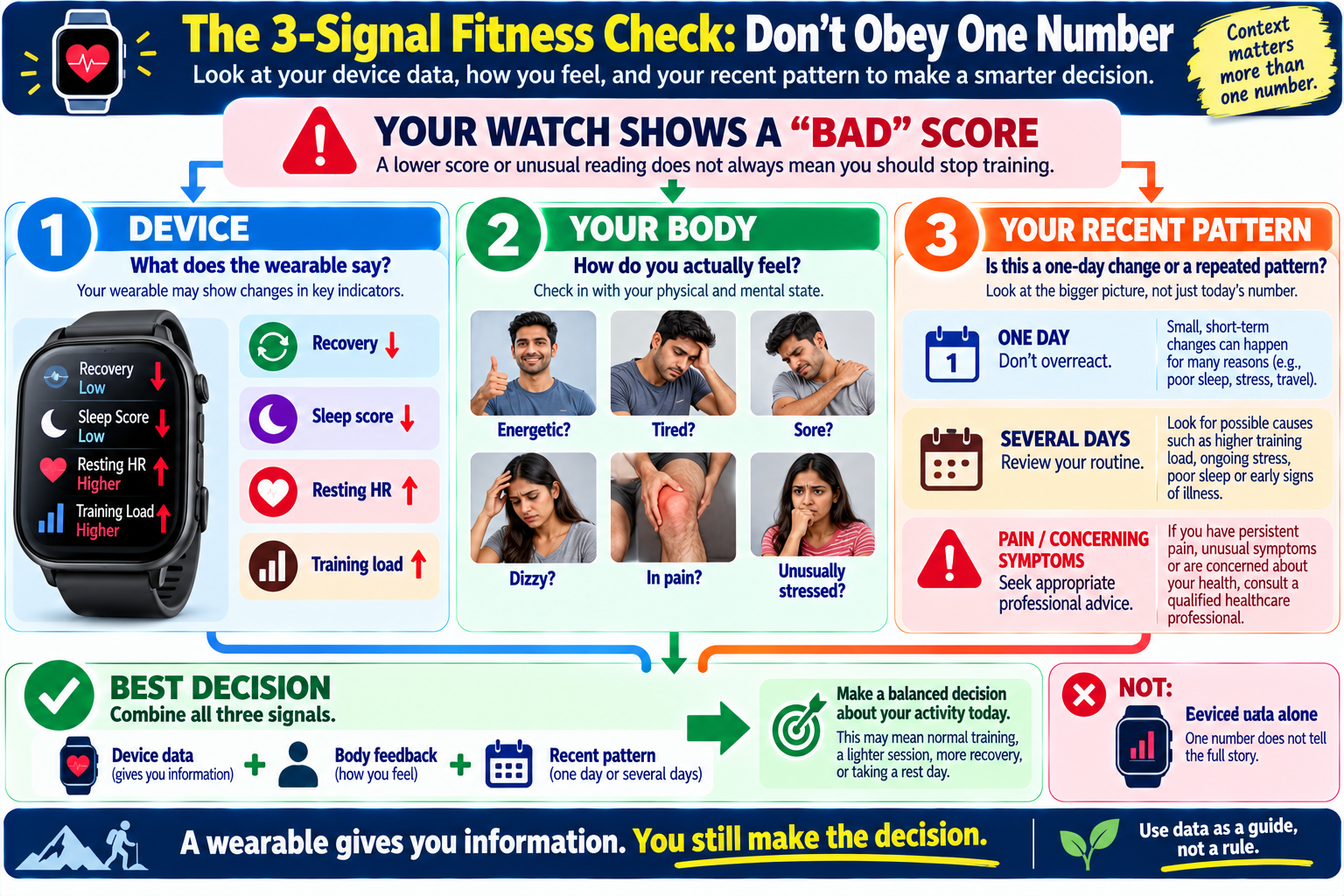
This is one of the most important people-first ideas in the future of fitness.
Suppose your watch says:
Recovery: 42
Should you cancel your workout?
Not necessarily.
You should also consider:
- How did you sleep?
- Do your muscles feel unusually sore?
- Do you feel energetic?
- Are you experiencing pain?
- Have you recently increased training volume?
- Are you sick?
- Are you unusually stressed?
- Does today’s workout match your normal training?
The device provides one piece of information.
Your body provides another.
The smartest approach is to combine both.
Use the three-signal rule.
Before changing your workout because of a wearable score, consider:
Signal 1: Device data
What does the technology show?
Signal 2: Body feedback
How do you actually feel?
Signal 3: Recent pattern
Has this happened once, or has it continued for several days?
This simple system prevents one unusual number from controlling your entire routine.
AI Versus a Human Coach: Who Wins?
This should not be treated as a competition.
AI is particularly useful for:
- Generating workout ideas
- Explaining exercises
- Creating simple routines
- Adjusting sessions around available equipment
- Providing reminders
- Organizing training data
- Answering basic fitness questions
- Helping beginners understand terminology
A qualified human professional is particularly valuable for:
- Assessing movement problems
- Working with injuries
- Managing complex medical conditions
- Understanding individual history
- Observing technique in context
- Making nuanced safety decisions
- Providing accountability and motivation
- Knowing when exercise should be stopped or modified
The strongest future model may combine both.
AI handles information and personalization.
Humans handle judgment, context, and responsibility.
The Home Workout Revolution Is Becoming More Practical
You do not need a high-end home gym to benefit from smart fitness technology.
A simple setup can include:
- Smartphone
- Basic fitness tracker
- Resistance band
- Mat
- Comfortable walking shoes
- Timer
- Free or low-cost fitness app
The technology can help organize the session.
Your body still performs the work.
A simple PLAN–TRACK–ADAPT–REVIEW method
PLAN
Choose one clear objective.
For example:
“Today I will complete 20 minutes of moderate exercise.”
TRACK
Record useful information such as duration, steps or heart rate.
ADAPT
Change the next session based on how the previous session felt.
REVIEW
Look at the weekly pattern rather than obsessing over one day.
This approach prevents fitness technology from becoming another source of pressure.
A Smart 20-Minute Technology-Assisted Workout
Here is a practical example that does not require an expensive device.
| Time | Activity | Technology use |
|---|---|---|
| 0–3 minutes | Easy walking and mobility | Start timer. |
| 3–8 minutes | Brisk walking or low-impact cardio | Monitor effort |
| 8–14 minutes | Squats, wall push-ups, and rows with a band | Count repetitions. |
| 14–17 minutes | Faster walking or marching | Check perceived effort. |
| 17–20 minutes | Slow walking and breathing | Record session |
For healthy adults, the broader goal should still be regular physical activity rather than chasing a perfect daily technology score. WHO recommends adults accumulate at least 150 minutes of moderate-intensity activity or 75 minutes of vigorous activity each week, with muscle-strengthening activity on at least two days.
WHO Physical Activity Guidelines
Technology should help you reach those fundamentals.
It should not distract you from them.
The Future May Be More About Recovery Than Calories
For years, many fitness devices emphasized calories.
But calories are not always the most useful metric.
Future fitness systems may increasingly focus on the relationship between:
Training + Sleep + Stress + Recovery + Performance
For example, a system could identify that your running performance consistently falls after several nights of poor sleep.
That information could be more useful than telling you that yesterday’s workout burned 437 calories.
The goal is to understand patterns.
The better question
Instead of:
“How many calories did I burn?”
Ask:
“What does my activity pattern tell me about how I am training?”
That shift can make fitness technology more useful and less obsessive.
A Unique Strategy: Create Your Own Personal Baseline
You do not need to compare your numbers with professional athletes.
Your own baseline can be more useful.
For two to four weeks, observe:
- Typical daily steps
- Normal resting heart rate
- Typical workout duration
- Usual sleep duration
- Exercise frequency
- How you feel after training
Then compare future measurements with your own normal range.
This is often more meaningful than chasing numbers from social media.
For example, if you normally walk 5,000 steps but suddenly average 2,500 for several days, that change may be worth investigating.
The reason could be workload, weather, illness, travel, poor sleep, or simply a change in routine.
The number does not tell you the reason.
It tells you where to look.
Another Overlooked Idea: Fitness Technology Should Reduce Friction
Many people do not stop exercising because they lack information.
They stop because exercise feels inconvenient.
The future of fitness should therefore make exercise easier to start.
Try these simple changes:
Keep the tracker charged.
A dead device cannot provide useful feedback.
Keep workout equipment visible.
A resistance band next to your desk may remind you to move.
Save a 10-minute workout.
When you have little time, you do not need to decide what to do.
Use technology to remove decisions.
Prepare tomorrow’s workout tonight.
Create a “minimum workout.”
On difficult days, your minimum might be
10 minutes of walking + 5 minutes of strength exercises.
This protects consistency without demanding perfection.
The Mental Side of Smart Fitness
Technology can motivate some people.
It can also create anxiety in others.
You may begin thinking:
“I have only walked 7,800 steps.”
“I did not reach my calorie target.”
“My sleep score is poor.”
“My recovery score dropped.”
That can turn health tracking into constant self-monitoring.
A people-first fitness system should improve your relationship with exercise rather than make you feel controlled by numbers.
If checking your device makes you anxious, consider reducing how frequently you check it.
You can still exercise effectively without monitoring every metric.
Privacy Is Part of the Future of Fitness
Fitness technology collects personal information.
Depending on the device and app, this can include:
- Activity data
- Heart rate
- Sleep information
- Location
- Exercise history
- Health-related measurements
- Personal goals
Privacy, therefore, needs to be part of the fitness conversation.
The U.S. Federal Trade Commission specifically notes that mobile health applications may collect and share information relating to fitness, wellness, sleep, activity, and other health-related areas.
FTC: Mobile Health Apps Interactive Tool
Before connecting a fitness app to multiple services, ask:
- What data does the app collect?
- Why does it need the data?
- Who can access it?
- Can I delete my information?
- Does the app share information with third parties?
- What happens if I stop using the service?
The smartest fitness technology should not only be accurate and useful.
It should also respect user privacy.
Common Mistakes People Make With Fitness Technology
Mistake 1: Believing every number is exact
A wearable estimate is still an estimate.
Mistake 2: Using calorie numbers to decide how much to eat
Energy expenditure estimates can be inaccurate, so they should not be treated as precise measurements.
Mistake 3: Letting an AI create a medical exercise plan
AI can provide general information, but people with medical conditions, injuries, or complex exercise needs should obtain appropriate professional guidance.
Mistake 4: Chasing badges instead of health
Completing a digital target is not the same thing as becoming healthier.
Mistake 5: Changing workouts because of one bad score
Look for patterns rather than reacting to every fluctuation.
Mistake 6: Buying expensive technology before building consistency
A basic walking routine can provide enormous health value without an expensive smartwatch.
Mistake 7: Ignoring how you feel
Your device does not experience your fatigue, pain, motivation, or stress in the same way you do.
What the Next Five Years Could Look Like
The future of fitness is likely to develop in several directions.
Adaptive workouts
Workout plans may change automatically according to recent performance and recovery information.
Better movement analysis
Camera-based systems may become more capable of identifying movement patterns during home workouts.
More connected devices
Smartwatches, rings, phones, gym equipment, and health applications may communicate more seamlessly.
Conversational fitness assistants
Instead of navigating multiple menus, users may simply ask:
“What should I do today?”
The system could respond based on their available time, recent training, and goals.
Recovery-aware programming
Workout intensity may increasingly be influenced by sleep and recovery trends.
More personalized home fitness
People may receive highly individualized programs without needing a large amount of equipment.
Stronger emphasis on privacy
As health data becomes more valuable, privacy and data governance will become increasingly important.
The Biggest Development to Watch: Better Interpretation
The future may not be about collecting more metrics.
We already have plenty of numbers.
The challenge is understanding them.
A future fitness system should ideally tell you:
What changed?
Why might it matter?
What should I do next?
How confident are we in that recommendation?
That last question is especially important.
An intelligent fitness system should be able to communicate uncertainty.
For example:
“Your sleep duration appears lower than your recent average, but wearable sleep-stage estimates are uncertain.”
That is more responsible than
“Your recovery is poor. Do not exercise.”
People-First Insight: Technology Should Serve the Routine
The best fitness device is not necessarily the most advanced one.
It is the one that helps you follow a routine you can maintain.
For one person, that may be a smartwatch, while another may prefer a phone timer or, alternatively, a simple notebook and a pair of walking shoes.
The technology should fit the person rather than forcing the person to fit the technology.
This is particularly important for beginners.
A complicated dashboard can create unnecessary friction, whereas a simple daily reminder to walk may be more useful and easier to follow.
A Simple Weekly Smart Fitness System
Try this seven-day approach.
Day 1: Establish your baseline
Record your normal activity without trying to improve everything immediately.
Day 2: Identify your biggest gap
Maybe you sit too long during work.
Day 3: Add one movement break.
Walk for five minutes during a convenient part of the day.
Day 4: Add strength training
Complete a short bodyweight routine.
Day 5: Review recovery
Look at sleep, soreness, and energy rather than one wearable score.
Day 6: Repeat what worked.
Consistency matters more than novelty.
Day 7: Review the week
Ask:
- “What made exercise easier?”
- “What made it harder?”
- “What should I change next week?”
This turns fitness technology into a learning tool.
How to Choose Fitness Technology Without Overspending
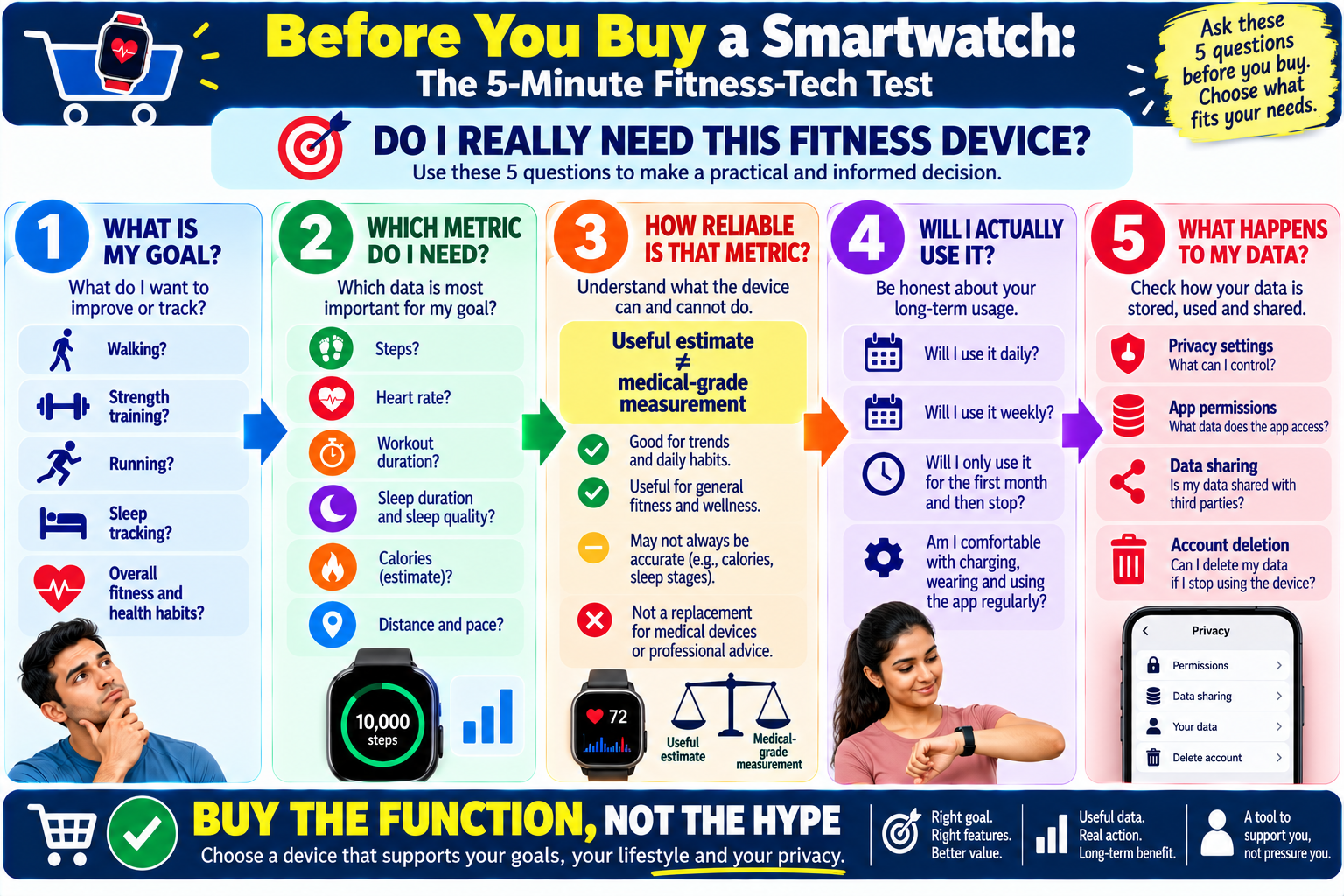
Before buying a wearable or subscribing to an AI fitness platform, ask five questions.
| Question | Why it matters |
|---|---|
| What is my main goal? | Prevents buying unnecessary features |
| Which metric do I actually need? | Keeps the system simple |
| Is the measurement validated? | Helps avoid overconfidence |
| Will I use it consistently? | A great device is useless if ignored. |
| Does the service protect my data? | Health information deserves care. |
You do not need every feature.
- If your main goal is walking more, a simple activity tracker may be enough.
- If your goal is structured training, heart-rate monitoring may be useful.
- If you need medical monitoring, consumer fitness technology should not automatically be considered a substitute for clinically appropriate equipment or professional care.
Latest Research: What Has Changed Most Recently?
The 2026 evidence base gives a more balanced picture of fitness technology than many promotional articles.
First, wearable technology has become a major fitness trend. ACSM ranked it number one for 2026, reflecting continued adoption and increasingly sophisticated sensors.
Second, wearables can help physical activity. Systematic reviews suggest they can increase activity, particularly when monitoring is combined with behavioral strategies.
Third, measurement quality varies. Recent reviews continue to show that heart rate and step measurements can be useful, while calorie expenditure, sleep staging, activity intensity, and some advanced metrics remain more uncertain.
Fourth, AI has real potential but is not ready to replace human exercise expertise. Current research supports AI as an assistance tool, while safety and personalization remain important limitations.
Fifth, privacy is becoming part of fitness technology literacy. As devices collect increasingly detailed information, consumers need to understand how that data is handled.
Together, these findings suggest that the future is not simply “more AI.”
It is better integration of technology, evidence, and human judgment.
Key Takeaways
- The future of fitness is moving from simple tracking toward personalized decision support.
- Wearable technology is a major 2026 fitness trend.
- Wearables can help people become more physically active, especially when combined with behavioral support.
- Not every wearable measurement is equally accurate.
- Calorie expenditure and detailed sleep-stage measurements deserve particular caution.
- AI can help create and adapt workout ideas, but it should not replace qualified professionals for complex cases.
- Your wearable should inform your decisions rather than control them.
- Looking at trends over several days is often more useful than reacting to one score.
- Privacy should be considered when choosing fitness apps and connected devices.
- The best technology is the technology you can use consistently.
- The fundamentals remain unchanged: regular movement, strength training, recovery, sleep, and sustainable habits.
Frequently Asked Questions
Is AI the future of fitness?
AI is likely to become an important part of fitness technology, particularly for personalized workout planning, coaching support, data interpretation, and movement analysis. However, current evidence does not support treating AI as a complete replacement for qualified exercise professionals.
Are fitness trackers accurate?
Accuracy depends on the device, metric, and activity. Heart rate and step counts can be reasonably useful for many everyday purposes, while calorie expenditure, sleep stages, and some advanced estimates can have substantially greater uncertainty.
Can a smartwatch improve fitness?
A smartwatch can support fitness by providing feedback, reminders, and activity monitoring. Research suggests wearable interventions can increase physical activity, but the device itself does not guarantee better fitness.
Should I follow my watch’s recovery score?
Use it as one piece of information rather than an absolute instruction. Consider your sleep, soreness, stress, recent training, and how you actually feel before changing your workout.
Can AI create a personalized workout?
AI can create a workout based on information you provide, such as goals, available equipment, and time. However, personalized wording does not guarantee that the recommendation is physiologically or medically appropriate.
Can AI replace a personal trainer?
Not reliably for all situations. AI can assist with information, planning, and routine adjustments, while human professionals provide observation, context, safety judgment, and individualized supervision.
Are wearable sleep scores medically accurate?
Wearable sleep data can help identify broad patterns, but current evidence shows that consumer devices do not consistently match clinical sleep testing or validated assessments closely enough to serve as universal diagnostic tools.
Do I need a fitness tracker to become healthy?
No. Walking, strength training, recreational activity, and other forms of movement can improve health without wearable technology. WHO emphasizes that all movement counts and recommends regular aerobic and muscle-strengthening activity for adults.
Author Note
Author: RVLNSV PRASAD
Fitness technology is changing quickly, but I believe the most useful technology is the technology that makes healthy behavior easier rather than making people obsessed with numbers.
A smartwatch can show you that you moved less today. AI can suggest a workout. An app can remind you to exercise.
But you still have to decide what fits your body, schedule, and goals.
The most sustainable approach is to use technology as a guide while keeping human judgment at the center of your fitness routine.
Medical Disclaimer
This article is for general educational purposes and does not replace medical advice, diagnosis, or treatment from a qualified healthcare professional.
Wearable devices and fitness applications can provide estimates and should not automatically be treated as medical-grade diagnostic tools. If you have chest pain, unexplained shortness of breath, fainting, severe dizziness, persistent abnormal heart symptoms, or another concerning symptom during exercise, stop exercising and seek appropriate medical attention.
People with heart disease, diabetes, uncontrolled blood pressure, significant musculoskeletal problems, pregnancy-related exercise considerations, or other medical conditions should discuss appropriate exercise with a qualified healthcare professional.
Fitness Disclaimer
Exercise recommendations in this article are general and intended for generally healthy adults.
Start at a level appropriate for your current fitness and gradually increase activity. Do not use an AI-generated workout as a substitute for professional assessment when you have an injury, medical condition, or unusual symptoms.
Sources
The evidence behind this article should be checked directly rather than relying on fitness marketing claims.
- American College of Sports Medicine — 2026 Worldwide Fitness Trends:
https://acsm.org/top-fitness-trends-2026/ - PubMed — Artificial Intelligence in Exercise Programming and Coaching:
https://pubmed.ncbi.nlm.nih.gov/42554743/ - PubMed — The AI Recommendation Paradox:
https://pubmed.ncbi.nlm.nih.gov/42422387/ - PubMed — Wearable Devices to Improve Physical Activity and Reduce Sedentary Behaviour:
https://pubmed.ncbi.nlm.nih.gov/38219269/ - PubMed — Wearable Activity Tracker Interventions in Older Adults:
https://pubmed.ncbi.nlm.nih.gov/40179387/ - PubMed — Accuracy of Consumer Wearable Technologies:
https://pubmed.ncbi.nlm.nih.gov/39080098/ - PubMed — Wearable Sleep Metrics and Patient-Reported Sleep Quality:
https://pubmed.ncbi.nlm.nih.gov/41946254/ - PubMed — Wearable Sleep Tracking Compared With Polysomnography:
https://pubmed.ncbi.nlm.nih.gov/42175611/ - World Health Organization — Physical Activity Guidelines:
https://www.who.int/publications-detail-redirect/9789240015128 - Federal Trade Commission — Mobile Health Apps and Privacy:
https://www.ftc.gov/business-guidance/resources/mobile-health-apps-interactive-tool
Final Thoughts
The future of fitness will probably not be defined by one smartwatch, one AI application, or one revolutionary piece of equipment.
It will be defined by how intelligently different technologies work together.
Wearables can collect information.
AI can help interpret patterns.
Apps can organize routines.
Connected equipment can provide feedback.
But the person remains at the center.
The healthiest approach is not to ask technology to make every decision.
Instead, use technology to answer better questions.
- Am I moving enough?
- Am I recovering adequately?
- Is my routine becoming more consistent?
- What makes exercise easier for me?
- What should I change based on the pattern I am seeing?
That is where technology becomes genuinely useful.
The future of fitness is not about replacing human judgment with machines.
It is about using better information to make better human decisions.
Related Content
- Healthy Habits
- The 5 Most Rare Diseases in the World
- 3 Best Tips To Maintain Fitness
- Fuel Your Body Right: 6 Best Ultimate Guide to Smart Nutrition
- The Future of Health: Shaping a Healthier America
- Smart Nutrition and Active Living: Keys to a Healthier USA